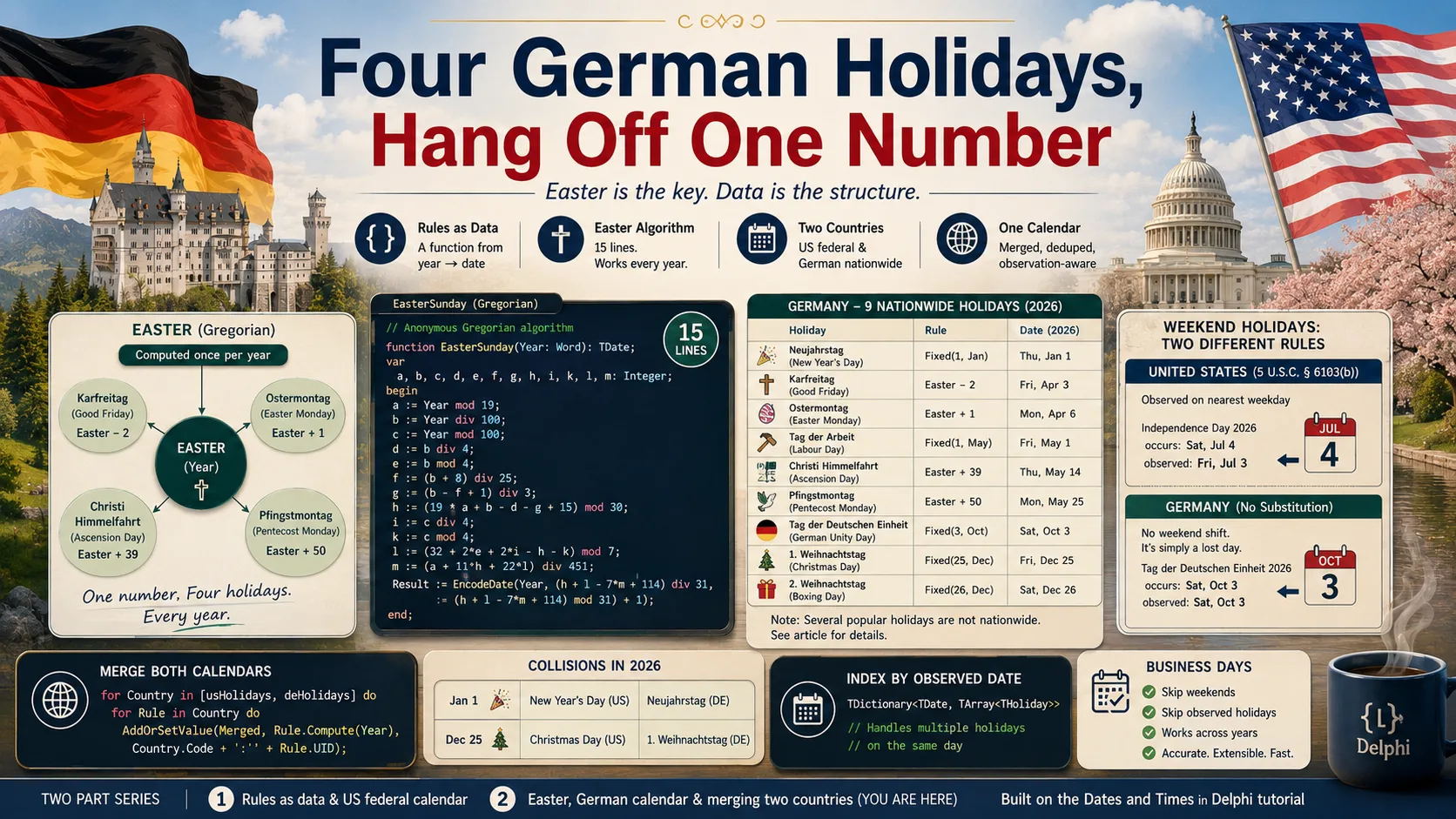
Part 1 built a holiday engine out of data instead of branches: a record holding a stable identifier, a display name, and an anonymous method that turns a year into a date. Eleven US federal holidays fit into that structure with three small primitives — a fixed date, the nth weekday of a month, and the last weekday of a month — and the code that evaluates them never branches on rule type at all.
Germany is where that design gets tested, because the German calendar contains a kind of rule the US calendar doesn't have. Four of the nine nationwide German holidays aren't anchored to the Gregorian calendar at all. They're anchored to Easter — and Easter is not a date you can look up in a statute. It's the result of a calculation that reconciles a solar calendar with a lunar one, standardized at the Council of Nicaea in 325 AD, and it moves across a 35-day window from year to year.
The good news is that the whole thing fits in about fifteen lines. This post implements Easter, adds the German rule table, handles the fact that the two countries treat weekend holidays completely differently, and merges both calendars into one — all without touching the evaluation loop from Part 1. That last part is the real point: a good data structure absorbs a genuinely new kind of rule without a rewrite.
Why Easter moves
Easter is the first Sunday after the first ecclesiastical full moon on or after 21 March. Every clause in that sentence is doing work: the ecclesiastical full moon is a tabular approximation rather than an astronomical observation, 21 March is a fixed stand-in for the equinox, and the "first Sunday after" is what pins the result to a weekday. The consequence is that Easter can fall anywhere from 22 March to 25 April.
The diagram is the reason this is worth the effort: Easter is the only genuinely hard computation in the German calendar, and once you have it, four holidays are one IncDay call each. The offsets are fixed — they never vary by year — so the hard part is solved exactly once.
The algorithm, in fifteen lines
The standard way to compute Gregorian Easter is the anonymous Gregorian algorithm, usually credited to Gauss and refined into the form below by Butcher and Meeus. It's a sequence of integer divisions and remainders that reconstructs the lunar cycle, and it's valid for any year in the Gregorian calendar. I'm reproducing it as documented on Wikipedia, keeping the traditional single-letter variable names because they make it checkable against every other published implementation:
/// Easter Sunday (Western/Gregorian) for AYear.
/// Anonymous Gregorian algorithm (Gauss / Meeus-Jones-Butcher).
function EasterSunday(const AYear: Word): TDate;
var
  a, b, c, d, e, f, g, h, i, k, l, m, Month, Day: Integer;
begin
  a := AYear mod 19;
  b := AYear div 100;
  c := AYear mod 100;
  d := b div 4;
  e := b mod 4;
  f := (b + 8) div 25;
  g := (b - f + 1) div 3;
  h := (19 * a + b - d - g + 15) mod 30;
  i := c div 4;
  k := c mod 4;
  l := (32 + 2 * e + 2 * i - h - k) mod 7;
  m := (a + 11 * h + 22 * l) div 451;
  Month := (h + l - 7 * m + 114) div 31;         // 3 = March, 4 = April
  Day   := ((h + l - 7 * m + 114) mod 31) + 1;
  Result := EncodeDate(AYear, Month, Day);
end;
I won't pretend the individual steps are intuitive — they're a compressed reconstruction of the Metonic cycle, and the intermediate values don't correspond to anything you'd recognize as a date. What matters practically is that it's deterministic, dependency-free, and testable against known values. Easter 2026 is 5 April, 2027 is 28 March, and 2024 was 31 March; if your implementation reproduces those three, you've almost certainly typed it in correctly.
The four derived holidays are then a matter of adding days, which is what IncDay from System.DateUtils is for:
function EasterOffset(const AYear: Word; const ADays: Integer): TDate;
begin
  Result := IncDay(EasterSunday(AYear), ADays);
end;
The offsets are worth stating precisely because two of them are traditionally quoted as different numbers. Christi Himmelfahrt is Easter + 39, not + 40, even though it's called the fortieth day after Easter — the ancient convention counts Easter Sunday itself as day one. Pfingstmontag is Easter + 50 for the same reason: Pentecost is the fiftieth day counting inclusively, landing it on Easter + 49, and the Monday after is + 50.
The German table: nine holidays every state agrees on
Germany's holiday law works differently from the American federal model, and the difference is worth getting right rather than glossing over. Holidays are set by the states — each Bundesland has its own Feiertagsgesetz — so there is no single federal list. What exists instead is an overlap: nine days that all sixteen states independently designate. Those are the bundeseinheitliche Feiertage, and they're the honest scope for a general-purpose calendar.
The one genuine exception is the Tag der Deutschen Einheit, which is fixed by federal law in Article 2(2) of the Einigungsvertrag, the 1990 reunification treaty. Everything else on the list is state law that happens to agree everywhere:
function GermanRules: TArray<THolidayRule>;
begin
  Result := [
    THolidayRule.Create('neujahr', 'Neujahrstag',
      function(const Y: Word): TDate begin Result := Fixed(Y, 1, 1); end),
    THolidayRule.Create('karfreitag', 'Karfreitag',
      function(const Y: Word): TDate begin Result := EasterOffset(Y, -2); end),
    THolidayRule.Create('ostermontag', 'Ostermontag',
      function(const Y: Word): TDate begin Result := EasterOffset(Y, 1); end),
    THolidayRule.Create('tag-der-arbeit', 'Tag der Arbeit',
      function(const Y: Word): TDate begin Result := Fixed(Y, 5, 1); end),
    THolidayRule.Create('christi-himmelfahrt', 'Christi Himmelfahrt',
      function(const Y: Word): TDate begin Result := EasterOffset(Y, 39); end),
    THolidayRule.Create('pfingstmontag', 'Pfingstmontag',
      function(const Y: Word): TDate begin Result := EasterOffset(Y, 50); end),
    THolidayRule.Create('tag-der-deutschen-einheit', 'Tag der Deutschen Einheit',
      function(const Y: Word): TDate begin Result := Fixed(Y, 10, 3); end),
    THolidayRule.Create('erster-weihnachtstag', '1. Weihnachtstag',
      function(const Y: Word): TDate begin Result := Fixed(Y, 12, 25); end),
    THolidayRule.Create('zweiter-weihnachtstag', '2. Weihnachtstag',
      function(const Y: Word): TDate begin Result := Fixed(Y, 12, 26); end)
  ];
end;
Nine rules, four of which are Easter offsets, and the record from Part 1 accepted the new rule type without a single change. That's the design working: EasterOffset is just another function(Year): TDate, structurally indistinguishable from Fixed as far as the table is concerned.
Running the table for 2026 gives the nine dates below, with the Easter-derived four clustered in spring exactly as the offsets predict:
Neujahrstag                 Thu, 01 Jan 2026
Karfreitag                  Fri, 03 Apr 2026
Ostermontag                 Mon, 06 Apr 2026
Tag der Arbeit              Fri, 01 May 2026
Christi Himmelfahrt         Thu, 14 May 2026
Pfingstmontag               Mon, 25 May 2026
Tag der Deutschen Einheit   Sat, 03 Oct 2026
1. Weihnachtstag            Fri, 25 Dec 2026
2. Weihnachtstag            Sat, 26 Dec 2026
Karfreitag on 3 April and Ostermontag on 6 April bracket Easter Sunday on the 5th, and Christi Himmelfahrt is a Thursday — as it always is, being Easter Sunday plus 39 days. Those are useful invariants to assert in a test.
Where the two countries genuinely differ: weekends
Look at the German list again and note Tag der Deutschen Einheit falling on a Saturday in 2026, and the 2. Weihnachtstag doing the same. In Germany, that's simply a lost holiday — German law provides no mechanism for moving a holiday that lands on a weekend, and workers do not get a substitute day. It's a recurring topic of public grumbling in years like this one.
The United States does the opposite. Under 5 U.S.C. § 6103(b), a holiday falling on a Saturday is observed on the preceding Friday, and one falling on a Sunday is observed on the following Monday. So Independence Day 2026, a Saturday, is observed by federal employees on Friday 3 July.
This is the one place where a country-level flag is genuinely warranted, and the clean way to model it is to keep occurrence and observation as separate fields rather than overwriting one with the other:
type
  TWeekendRule = (wrNoShift, wrShiftToNearestWeekday);

  THolidayCalendar = record
    CountryCode: string;
    Rules: TArray<THolidayRule>;
    Weekend: TWeekendRule;
  end;

function ObservedDate(const ADate: TDate; const ARule: TWeekendRule): TDate;
begin
  Result := ADate;
  if ARule = wrNoShift then
    Exit;
  case DayOfTheWeek(ADate) of
    DaySaturday: Result := IncDay(ADate, -1);   // observed the Friday before
    DaySunday:   Result := IncDay(ADate, 1);    // observed the Monday after
  end;
end;
Keeping both dates means you can answer both questions from one table: "is today Christmas?" uses the occurrence date, and "is the office closed?" uses the observed one. Collapse them into a single field and you permanently lose the ability to ask the first question — which matters more than it sounds, because anniversary and age calculations want the real date, not the administrative one.
Merging both calendars
With both tables defined, a combined calendar is a fold over the countries, and the dictionary from Part 1 does the deduplication:
type
  TObservedHoliday = record
    UID: string;
    Name: string;
    CountryCode: string;
    Occurs: TDate;      // the actual calendar date
    Observed: TDate;    // the day off, after any weekend shift
  end;

function ComputeCalendars(const ACalendars: TArray<THolidayCalendar>;
  const AYear: Word): TArray<TObservedHoliday>;
var
  Cal: THolidayCalendar;
  Rule: THolidayRule;
  Item: TObservedHoliday;
  List: TList<TObservedHoliday>;
begin
  List := TList<TObservedHoliday>.Create;
  try
    for Cal in ACalendars do
      for Rule in Cal.Rules do
      begin
        Item.UID         := Rule.UID;
        Item.Name        := Rule.Name;
        Item.CountryCode := Cal.CountryCode;
        Item.Occurs      := Rule.Compute(AYear);
        Item.Observed    := ObservedDate(Item.Occurs, Cal.Weekend);
        List.Add(Item);
      end;
    List.Sort(TComparer<TObservedHoliday>.Construct(
      function(const L, R: TObservedHoliday): Integer
      begin
        Result := CompareDate(L.Occurs, R.Occurs);
        if Result = 0 then
          Result := CompareStr(L.CountryCode, R.CountryCode);
      end));
    Result := List.ToArray;
  finally
    List.Free;
  end;
end;
CompareDate rather than a raw < comparison is the Part 1 habit paying off — it compares the date portion only, so a stray time fraction on any TDate can't scramble the sort order. The country code as a tiebreak keeps the output stable when two holidays share a date, which brings us to the interesting collision.
Run both calendars for 2026 and two dates carry entries from both countries. 1 January is the obvious one — New Year's Day and Neujahrstag are the same day everywhere. The other is 25 December, Christmas Day and 1. Weihnachtstag. And there's a subtler near-miss worth noticing: Memorial Day 2026 and Pfingstmontag 2026 both fall on Monday 25 May — the last Monday in May colliding with a date derived from Easter, a coincidence that holds in 2026 and breaks in 2027, when Pfingstmontag is 17 May and Memorial Day is the 31st.
That collision is precisely why the index in Part 1 used AddOrSetValue. Build a TDictionary<TDate, string> over a merged calendar with plain Add and 2026 will raise a duplicate-key exception on 25 May — in production, in the one year it happens. A multi-value index is the honest structure once more than one country is in play:
function MergedIndex(const ACalendars: TArray<THolidayCalendar>;
  const AYear: Word): TDictionary<TDate, TArray<string>>;
var
  H: TObservedHoliday;
  Existing: TArray<string>;
begin
  Result := TDictionary<TDate, TArray<string>>.Create;
  for H in ComputeCalendars(ACalendars, AYear) do
  begin
    if not Result.TryGetValue(H.Observed, Existing) then
      Existing := [];
    Result.AddOrSetValue(H.Observed, Existing + [H.CountryCode + ': ' + H.Name]);
  end;
end;
Keying on Observed rather than Occurs is the right default here because the question this index answers is "is anyone off work today?" Swap the field if you're asking the calendrical question instead — and the fact that swapping one identifier changes the meaning cleanly is the last dividend of having kept both dates.
Putting it to work: business days
The payoff for all of this is usually a business-day calculation, which is now short enough to write inline. Note that it needs holidays from every year the range touches, which is the practical reason ComputeYear takes a year rather than caching a single global:
function AddBusinessDays(const AStart: TDate; const ACount: Integer;
  const AHolidays: TDictionary<TDate, TArray<string>>): TDate;
var
  Remaining: Integer;
begin
  Result := DateOf(AStart);
  Remaining := ACount;
  while Remaining > 0 do
  begin
    Result := IncDay(Result, 1);
    if (DayOfTheWeek(Result) in [DayMonday..DayFriday]) and
       (not AHolidays.ContainsKey(Result)) then
      Dec(Remaining);
  end;
end;
DayOfTheWeek being ISO-numbered is what makes [DayMonday..DayFriday] a legible range rather than a puzzle — with the Sunday-first DayOfWeek from SysUtils, the working week would wrap awkwardly around the set boundary. Small thing, but it's the difference between a line you read and a line you decode.
Takeaways
Two posts, two countries, and the evaluation loop never changed once.
- Easter is the only hard computation in either calendar, and it's fifteen lines of integer arithmetic with no dependencies. Four German holidays are then simple offsets from it.
- The offsets are +39 and +50, not +40 and +49 — the traditional counting includes the starting day, and off-by-one here is silent.
- Germany's nine nationwide holidays are an overlap, not a federal list. Only the Tag der Deutschen Einheit is set federally; the other eight are sixteen state laws that agree.
- Occurrence and observation are different dates. The US shifts weekend holidays to the nearest weekday; Germany never shifts anything. Keep both fields and you can answer both questions.
- Two holidays can share a date — Memorial Day and Pfingstmontag collide on 25 May 2026 — so any index over a merged calendar needs to expect it.
The hard part of a holiday calendar isn't the algorithm, it's the modeling. Get "a holiday is a function from a year to a date" right and Easter, weekend shifts, and a second country all slot in without a rewrite.
If you want the groundwork underneath all of this — what a TDateTime actually is, and the System.DateUtils functions these two posts lean on throughout — the Dates and Times in Delphi tutorial covers it in two parts, including the time-zone discipline that matters the moment your holiday calendar is consumed by a client in another country.