Every business application eventually needs to know whether a given day is a working day. Payroll needs it. Delivery-date estimates need it. Anything that computes an SLA in business days needs it. And the first version of that code, in almost every codebase I've seen, is a case statement that grows a new branch every December.
The problem isn't the branches. It's that a holiday isn't a date — it's a rule. "Christmas Day" is a fixed date and always will be. But "Thanksgiving" is the fourth Thursday in November, "Memorial Day" is the last Monday in May, and "Ostermontag" is whatever day follows a lunisolar calculation that predates the computer by about fifteen centuries. Hard-code the dates and you're back next year. Encode the rules and you're done forever.
This is a two-part series on doing exactly that in Delphi, built entirely on System.DateUtils — the RTL unit I toured in Part 1 of the DateUtils series. This part builds the data structure and the three date primitives every rule-based holiday is made of, then uses them to express all eleven US federal holidays in a single readable array. Part 2 takes on the interesting half — Easter, the four German holidays that hang off it, and merging two national calendars into one. By the end you'll have a holiday engine that's about a hundred lines and never needs updating.
A holiday is a function from a year to a date
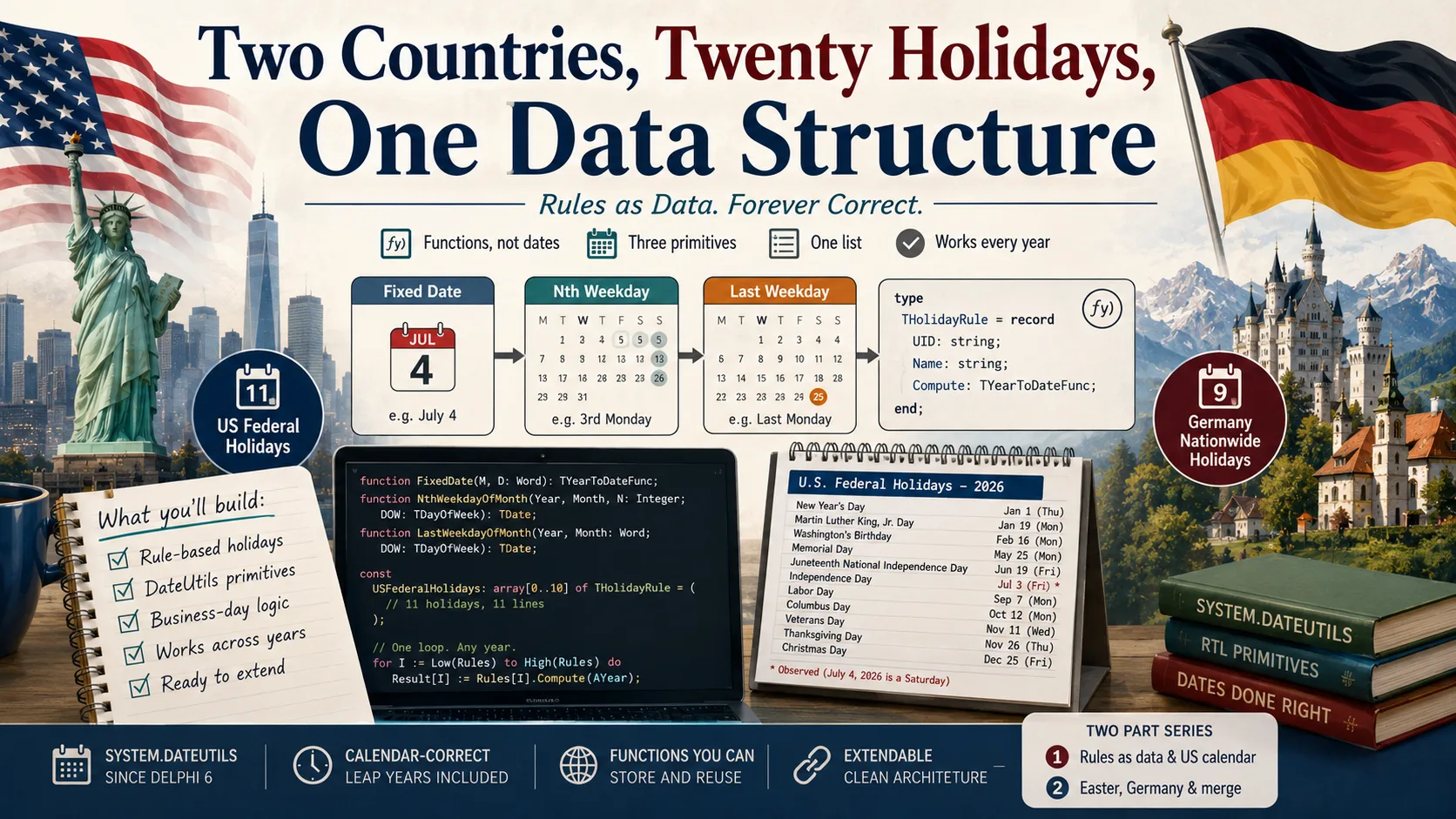
The insight that makes all of this collapse is small: whatever else a holiday is culturally, computationally it is a function that takes a year and returns a date. 2026 → 2026-11-26. Nothing more. Once every holiday has that same shape, they all fit in one list, and the code that uses the list never needs to know which kind of rule it's looking at.
Read the diagram left to right and you have the whole architecture. Four structurally different kinds of rule — and because they share a signature, the calling code has exactly one path through it. There is no if Kind = hkFixed then … else if Kind = hkNthWeekday then … anywhere in what follows. That branch is precisely what we're designing out.
Delphi expresses "a function you can store in a variable" with an anonymous method type, declared with reference to:
uses
  System.SysUtils, System.DateUtils, System.Generics.Collections;

type
  /// Computes the date this holiday falls on in a given year.
  TComputeHoliday = reference to function(const AYear: Word): TDate;

  THolidayRule = record
    UID: string;      // stable identifier — safe to store in a database
    Name: string;     // display name
    Compute: TComputeHoliday;
    constructor Create(const AUID, AName: string; const ACompute: TComputeHoliday);
  end;

constructor THolidayRule.Create(const AUID, AName: string;
  const ACompute: TComputeHoliday);
begin
  UID := AUID;
  Name := AName;
  Compute := ACompute;
end;
The UID deserves a word, because it's the field people leave out and regret. Display names change — they get translated, they get re-spelled, and in one memorable case a US holiday's name was amended by statute. A stable machine identifier means a row in your database that says "this employee took memorial-day off" still means something after any of that.
The three primitives, and why each one is a one-liner
The eleven US federal holidays are defined by 5 U.S.C. § 6103, and reading the statute closely is genuinely useful here: it uses exactly three phrasings. Some holidays are a calendar date ("January 1"). Some are an ordinal weekday ("the third Monday in January"). One is a terminal weekday ("the last Monday in May"). That's the entire vocabulary, so that's exactly three helper functions.
The first one barely needs writing, but naming it pays off in how the rule table reads:
function Fixed(const AYear, AMonth, ADay: Word): TDate;
begin
  Result := EncodeDate(AYear, AMonth, ADay);
end;
The second is the interesting one. To find the nth Monday of a month, start at the 1st, ask which weekday that is, step forward to the first Monday, then add whole weeks. DayOfTheWeek from System.DateUtils is the right tool because it's ISO 8601-numbered — Monday is 1 through Sunday is 7 — which lets the arithmetic stay honest:
/// The ANth occurrence of ADayOfWeek in a month.
/// ADayOfWeek uses the DateUtils constants: DayMonday = 1 .. DaySunday = 7.
function NthWeekdayOfMonth(const AYear, AMonth, ADayOfWeek, ANth: Word): TDate;
var
  FirstOfMonth: TDate;
  Offset: Integer;
begin
  FirstOfMonth := EncodeDate(AYear, AMonth, 1);
  // How many days forward from the 1st to the first ADayOfWeek?
  Offset := (Integer(ADayOfWeek) - DayOfTheWeek(FirstOfMonth) + 7) mod 7;
  Result := IncDay(FirstOfMonth, Offset + 7 * (Integer(ANth) - 1));
end;
The + 7) mod 7 is the part worth pausing on: it turns a possibly-negative difference into a forward step of 0–6 days, so the function works whether the 1st falls before or after the target weekday. Drop it and the calendar is right about half the time — which is exactly the kind of bug that survives testing in January and surfaces in September.
The third primitive works backward from the end of the month, and this is where EndOfTheMonth from Part 1 earns its keep by knowing how long every month is, leap years included:
/// The last occurrence of ADayOfWeek in a month.
function LastWeekdayOfMonth(const AYear, AMonth, ADayOfWeek: Word): TDate;
var
  LastOfMonth: TDate;
  Offset: Integer;
begin
  LastOfMonth := DateOf(EndOfTheMonth(EncodeDate(AYear, AMonth, 1)));
  // How many days back from the last day to the last ADayOfWeek?
  Offset := (DayOfTheWeek(LastOfMonth) - Integer(ADayOfWeek) + 7) mod 7;
  Result := IncDay(LastOfMonth, -Offset);
end;
Note DateOf wrapped around EndOfTheMonth: EndOfTheMonth returns the last millisecond of the month, 23:59:59.999, and we want a clean midnight date. It's a one-word fix that prevents a TDate carrying a stray time fraction into every comparison you later make against it.
!!! warning ""Last" is not "fifth," and it isn't "fourth" either"
This is the single most common bug in hand-rolled holiday code. Memorial Day is the last Monday in May — and May has five Mondays in some years and four in others, so neither NthWeekdayOfMonth(…, 4) nor NthWeekdayOfMonth(…, 5) is correct in general. In 2026 the last Monday of May is the 25th; in 2027 it's the 31st, which is the fifth. Ask for the fifth Monday of a May that only has four and NthWeekdayOfMonth will happily hand you a date in June. That's why LastWeekdayOfMonth counts backward from the end instead of forward from the start — the question "which is last" has an answer every year, and the question "is there a fifth" does not.
The US table: eleven holidays, eleven lines
With the primitives in place, the entire US federal holiday calendar becomes a list of rules that reads almost exactly like the statute it implements. This is the payoff for all the setup — and notice there is no logic here at all, just data:
function USRules: TArray<THolidayRule>;
begin
  Result := [
    THolidayRule.Create('new-years-day', 'New Year''s Day',
      function(const Y: Word): TDate begin Result := Fixed(Y, 1, 1); end),
    THolidayRule.Create('mlk-day', 'Martin Luther King Jr. Day',
      function(const Y: Word): TDate begin Result := NthWeekdayOfMonth(Y, 1, DayMonday, 3); end),
    THolidayRule.Create('presidents-day', 'Washington''s Birthday',
      function(const Y: Word): TDate begin Result := NthWeekdayOfMonth(Y, 2, DayMonday, 3); end),
    THolidayRule.Create('memorial-day', 'Memorial Day',
      function(const Y: Word): TDate begin Result := LastWeekdayOfMonth(Y, 5, DayMonday); end),
    THolidayRule.Create('juneteenth', 'Juneteenth National Independence Day',
      function(const Y: Word): TDate begin Result := Fixed(Y, 6, 19); end),
    THolidayRule.Create('independence-day', 'Independence Day',
      function(const Y: Word): TDate begin Result := Fixed(Y, 7, 4); end),
    THolidayRule.Create('labor-day', 'Labor Day',
      function(const Y: Word): TDate begin Result := NthWeekdayOfMonth(Y, 9, DayMonday, 1); end),
    THolidayRule.Create('columbus-day', 'Columbus Day',
      function(const Y: Word): TDate begin Result := NthWeekdayOfMonth(Y, 10, DayMonday, 2); end),
    THolidayRule.Create('veterans-day', 'Veterans Day',
      function(const Y: Word): TDate begin Result := Fixed(Y, 11, 11); end),
    THolidayRule.Create('thanksgiving', 'Thanksgiving Day',
      function(const Y: Word): TDate begin Result := NthWeekdayOfMonth(Y, 11, DayThursday, 4); end),
    THolidayRule.Create('christmas-day', 'Christmas Day',
      function(const Y: Word): TDate begin Result := Fixed(Y, 12, 25); end)
  ];
end;
Two naming notes, since precision matters when the source is a statute. The holiday most Americans call "Presidents' Day" is named Washington's Birthday in federal law — the statute has never been amended to change it, though many states use the other name. And Juneteenth's full legal name is Juneteenth National Independence Day, added to the list by the Juneteenth National Independence Day Act in 2021, which is why any holiday table written before then is missing a row. I've kept the legal names in Name and the familiar ones in the UID; if you're displaying these to users, a display-name lookup is the place to disagree with Congress.
Evaluating the table
Because every rule has the same signature, computing a year's calendar is one loop with no knowledge of rule types in it whatsoever:
type
  THoliday = record
    UID: string;
    Name: string;
    Date: TDate;
  end;

function ComputeYear(const ARules: TArray<THolidayRule>;
  const AYear: Word): TArray<THoliday>;
var
  I: Integer;
begin
  SetLength(Result, Length(ARules));
  for I := 0 to High(ARules) do
  begin
    Result[I].UID  := ARules[I].UID;
    Result[I].Name := ARules[I].Name;
    Result[I].Date := ARules[I].Compute(AYear);   // the only line that varies
  end;
end;
That single call ARules[I].Compute(AYear) is where the case statement went. Adding a twelfth holiday means adding a twelfth line to the table — this function never changes, and neither does anything downstream of it.
Printing the 2026 calendar is then a formality:
var
  H: THoliday;
begin
  for H in ComputeYear(USRules, 2026) do
    Writeln(Format('%-45s %s', [H.Name, FormatDateTime('ddd, dd mmm yyyy', H.Date)]));
end;
which produces the eleven days below. Worth spot-checking a couple against a calendar, because verified output is the only kind worth publishing:
New Year's Day                                Thu, 01 Jan 2026
Martin Luther King Jr. Day                    Mon, 19 Jan 2026
Washington's Birthday                         Mon, 16 Feb 2026
Memorial Day                                  Mon, 25 May 2026
Juneteenth National Independence Day          Fri, 19 Jun 2026
Independence Day                              Sat, 04 Jul 2026
Labor Day                                     Mon, 07 Sep 2026
Columbus Day                                  Mon, 12 Oct 2026
Veterans Day                                  Wed, 11 Nov 2026
Thanksgiving Day                              Thu, 26 Nov 2026
Christmas Day                                 Fri, 25 Dec 2026
Independence Day 2026 falls on a Saturday, which is a good reminder that "is a holiday" and "is a day off" are different questions — federal practice observes a Saturday holiday on the preceding Friday, per § 6103(b). That's an observation rule layered on top of the occurrence rule, and keeping the two separate is what lets you answer both questions from one table. I'll wire that up in Part 2, because Germany deliberately does not do it.
Is a lookup function worth it?
Once the year is computed, the questions you actually ask are "is this date a holiday?" and "which one?" A linear scan over eleven items is genuinely fine, but if you're calling it inside a business-day loop over a date range, a dictionary keyed by the date is nicer to use and turns the answer into a hash lookup:
function HolidayIndex(const ARules: TArray<THolidayRule>;
  const AYear: Word): TDictionary<TDate, string>;
var
  H: THoliday;
begin
  Result := TDictionary<TDate, string>.Create;
  for H in ComputeYear(ARules, AYear) do
    Result.AddOrSetValue(H.Date, H.Name);   // AddOrSetValue: two holidays can share a date
end;
AddOrSetValue rather than Add is not defensive padding — it's load-bearing. Two holidays landing on the same date is a real scenario, and it shows up the moment you merge two countries' calendars. That merge is Part 2's job, and it's where this data structure starts genuinely paying for itself.
Takeaways
Part 1 was really about one refactoring: turning behavior into data so the code that consumes it stops branching.
- A holiday is a function from a year to a date. Give every rule that signature and the calling code has exactly one path through it.
- Three primitives cover the entire US statute: a fixed date, the nth weekday of a month, and the last weekday of a month.
DayOfTheWeekandEndOfTheMonthdo the hard parts. - "Last" is not "fourth" or "fifth." Count backward from the end of the month; forward-counting silently produces dates in the following month.
- A stable
UIDalongside the display name keeps stored data meaningful when names get translated, re-spelled, or amended by legislation.
Encode the rule, not the date. A holiday table built from rules is written once and correct in every year you never tested.
The US calendar was the easy country: eleven holidays, all of them anchored to the Gregorian calendar we already compute in. Germany is the interesting one — four of its nine nationwide holidays are defined by their distance from Easter, and Easter is a lunisolar computation with no closed-form date at all. Part 2 implements it, adds the German table, and merges both countries into a single calendar with the same three-line loop. See you there.